
MECHANISM DRIVEN THERAPEUTICS
REFRAMING HEALING
REPURPOSING WHAT WORKS
At WiTii Pharmaceuticals, we are redefining how chronic diabetic wounds are treated; not by adding more signals, but by restoring the biological environment that allows healing to occur.
Our work combines drug repurposing with mechanism-driven innovation to unlock new therapeutic potential from known compounds applied in entirely new ways.
WELCOME TO WITII PHARMACEUTICALS
WiTii stands for: WHAT IF THIS IS INSANE?
This is more than a question—it’s a mindset. It challenges conventional thinking, pushes beyond accepted limitations, and drives us to uncover overlooked biological truths.
“Every great medical breakthrough starts with a question worth asking — WiTii Pharma exist to ask and answer those questions.”
THE PROBLEM
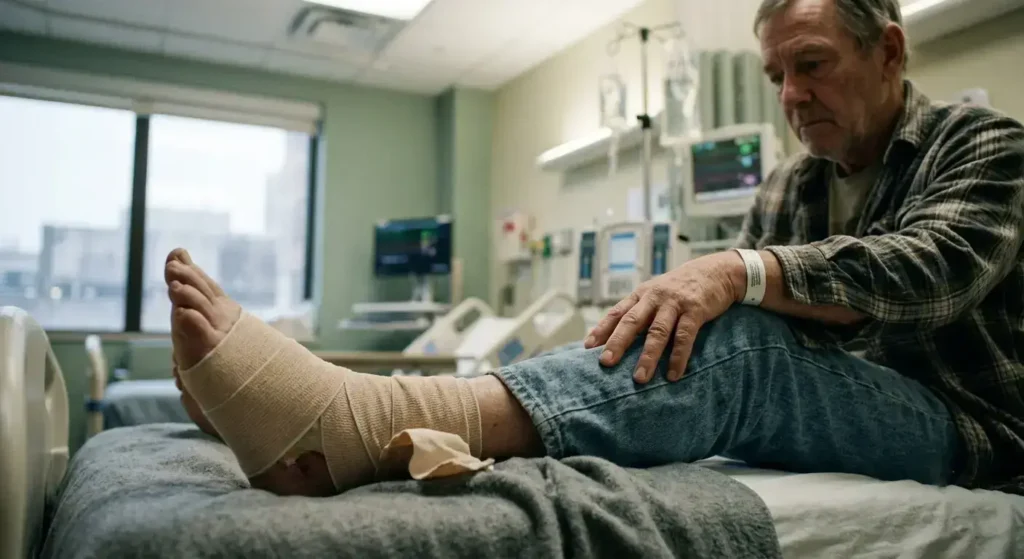
A Global Growing Burden
Millions of diabetic patients suffer from chronic, non-healing wounds.
- Diabetic Foot Ulcers (DFUs) are a leading cause of lower-limb amputations.
Existing therapies fail to consistently achieve durable healing.
Chronic wounds are not just slow to heal— they often fail to heal entirely, triggering a cascade of complications:
- Infection and hospitalization
- Progressive tissue damage
- Amputation
- Increased mortality risk
THE SCALE OF THE PROBLEM
GLOBAL:
- 537M+ people living with diabetes
- 19–34% will develop a diabetic foot ulcer (DFU) in their lifetime
- ~20% of DFU patients require lower-extremity amputation
- ~10% die within one year of their first DFU diagnosis
UNITED STATES:
40M+
Americans living with Diabetes
(about 12% of the U.S. population )
~19-34%
of Diabetic patients (1 in every 3 to 5 diabetic patient ) has a risk of DFUs
1.6 M
people affected by DFUs in US annually (Jama Network,2023)
~150K
amputations/ year
linked to Diabetes
(American Diabetes Association)
~1 amputation every 3-4 minutes
Diabetic foot ulcers are not just wounds—they are the starting point of nearly 85% of diabetes-related amputations. With early detection and proper care, most complications can be prevented.
Why This Matters
- Loss of mobility and independence
- Increased risk of mortality
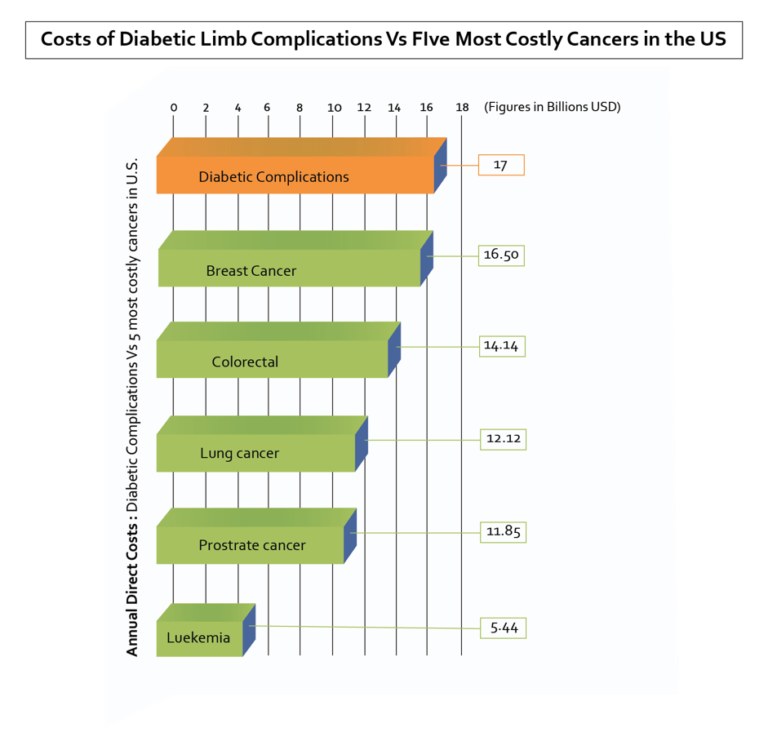
- Significant burden on healthcare systems
Despite multiple available treatments, outcomes remain inconsistent.
With decades of research and multiple treatments available—
WHY DOES HEALING STILL FAIL?
Our Thinking Framework
A Question-Led Approach to Chronic Wound Biology
Five questions that shift the entire therapeutic paradigm
Most treatments assume the problem is a deficiency of healing signals. WiTii starts with a more disruptive question: what if the entire framework is wrong?
The signals needed for healing are not absent — they are destroyed by the wound microenvironment before they can function. This single realization reframes the entire problem.
Chronic diabetic wounds are not simply stalled — they are locked in a state of active biological dysfunction that prevents repair even when all the inputs are present.
Rather than introducing more growth factors or stimulants, the therapeutic goal shifts to restoring the biological conditions that allow existing signals to function as intended.
WiTii's drug repurposing strategy applies clinically validated compounds with established safety profiles to address the root cause of healing failure — enabling faster timelines, lower risk, and stronger IP defensibility.
OUR APPROACH
WiTii’s approach begins with a question led approach. From the framework we reach to one conclusion: chronic wounds don’t fail because the body lacks the ability to heal. They fail because the wound environment actively prevents it.
WiTii’s response is not to introduce more signals — but to restore the conditions that allow existing ones to function. This is the core of our mechanism-driven approach: targeting the wound microenvironment itself, rather than its downstream effects.
We achieve this through drug repurposing .
WiTii applies a drug repurposing strategy—leveraging established compounds with known safety profiles and re-engineering their use based on new mechanistic understanding.
OUR SCIENCE AND INNOVATION
Science that Translates

Built on Validated Science
Grounded in validated scientific research and supported by compounds with existing clinical data—providing a strong, credible starting point for therapeutic development.
Repurposing with Clinical Data Advantage
We leverage clinically studied compounds and apply them in novel, mechanism-driven ways—accelerating development timelines, reducing risk, and improving capital efficiency.
Proprietary Biological Insights
Our research targets the underlying mechanisms that impair healing, enabling therapies designed to restore the body’s natural regenerative processes.
Defensible Innovation
Patent-protected applications and proprietary know-how create a foundation for long-term value, differentiation, and competitive advantage.
Drug repurposing substantially reduces development risk and timelines compared to de novo discovery — a key advantage for capital efficiency.
Why This Approach Wins
✓ Accelerated development pathway
✓ Reduced scientific and clinical risk
✓ Strong intellectual property protection
✓ Capital-efficient development strategy
✓ Clinically relevant and scalable approach
✓ Potential for expansion across multiple wound-healing indications
A Smarter Path to Innovation
Rather than starting from scratch, WiTii combines what is already known with what has not yet been connected.
By aligning repurposing with mechanism-driven insight, we create a pathway that is: Faster, Lower risk and Clinically meaningful
→ Enabling therapies to move more efficiently from discovery to patient impact
| Traditional Drug Discovery | WiTii Approach |
|---|---|
| 10–15 years development timeline | Accelerated development pathway |
| High discovery risk | Clinically studied compounds |
| Significant capital requirements | More capital-efficient strategy |
| Novel safety profile | Existing clinical and safety data |
A LARGE, GROWING, AND UNDER SERVED MARKET
A Multi-Billion Dollar Opportunity in Chronic Wound Care
Diabetic foot ulcers (DFUs) represent a large, growing, and underserved global market driven by rising diabetes prevalence, high treatment costs, and persistent gaps in clinical outcomes.
537M+
People living with diabetes globally
IDF Diabetes Atlas, 2021
1 in 3
Will develop a diabetic foot ulcer
Over their lifetime
~20%
Progress to amputation
Of all diabetic foot ulcer cases
~10%
Mortality within 1 year
Following major amputation
A rapidly expanding patient population with significant unmet clinical need
Market Momemtum
A rapidly expanding market driven by rising diabetes prevalence and persistent clinical gaps
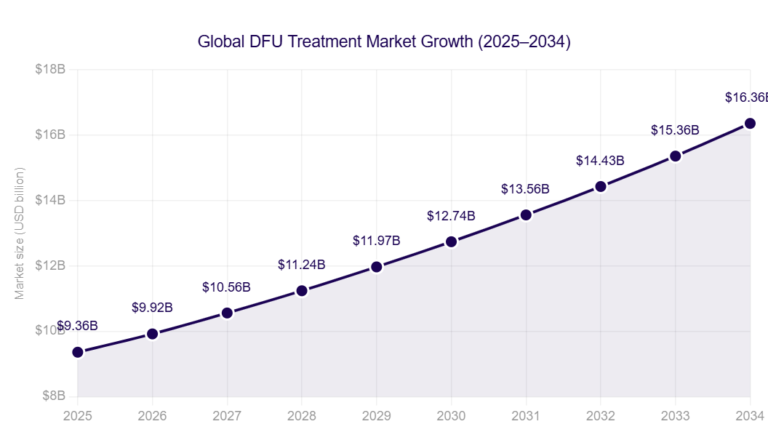
CAGR 6.44% · North America share 38.88% (2025) · Forecast period 2026–2034
Fortune Buisness Insights 2025
Already a rapidly expanding market, it is projected to grow steadily over the next decade:
- ~$9–10B today → $16B+ over the next decade
- Sustained growth driven by rising prevalence and aging populations
- The U.S. diabetic foot ulcer treatment market alone is projected to grow from ~$1.7B to nearly $3B over the next decade.
The Opportunity
High Cost Burden
$3K – $17K+
Cost per wound episode
Driven by hospitalizations, surgery, and long-term care
Treatment Gap Persists
Outcomes Remain Inconsistent
Healing failure continues despite multiple available therapies
Innovation Opportunity
Clear Need for Better Solutions
Opportunity for therapies that improve healing reliability and outcomes
Where Value Is Created
The challenge is not the absence of treatment but the failure to restore the biology of healing. Despite its scale, outcomes remain inconsistent creating a clear opportunity for therapies that improve the reliability of healing, not just the availability of treatments.
WiTii addresses this gap through a mechanism-driven, repurposing-based approach designed to restore the biological conditions required for healing to occur.
BACKED BY EXECUTION AND SCIENTIFIC CREDIBILITY
WiTii’s approach is supported by both measurable progress and strong scientific and operational foundations.
- Execution Milestones
- $540K+ secured through angel funding.
- $150K+ in R&D contracts executed validating external demand
- $180K in non-dilutive grant funding awarded for early-stage development
- Formulation and analytical lab already operating in Laramie (U.S.)
- Scientific & Strategic Credibility
- 100+ publications and patents from scientific leadership
- Advisory network spanning clinical, CRO, and regulatory experts across the drug development lifecycle
- Established development infrastructure supporting CMC, toxicology, and early clinical pathways
- Protected innovation & Partnerships
WiTii’s platform is supported by strong intellectual property and institutional backing:
- Method and method-of-use patents in chronic wound healing
- Exclusive licensing agreement with the University of Wyoming
- Proprietary scientific insights driving differentiated therapeutic applications
- The WiTii Advantage
- First-in-Class Mechanism Cathepsin K inhibition targeting a key biological driver of impaired healing.
- Faster Healing Signal ≥30% faster wound closure demonstrated in preclinical studies.
- Localized SafetyLocal delivery approach designed to minimize systemic exposure and risk.
- Cost Efficient Approach Small-molecule strategy offers advantages over expensive biologics and skin substitutes.
- Designed for Adoption Seamlessly integrates into standard wound care workflows.
Built on science. Proven through execution. Designed for real-world impact.
ENGAGE WITH WITII PHARMACEUTICALS
We are advancing a differentiated, mechanism-driven approach to chronic wound healing.
Additional information is available through direct engagement.