
OUR SCIENCE
MECHANISM OF ACTION
Rewriting The Biology of Chronic Wound Healing
WiTii’s lead candidate is the first therapy to directly inhibit Cathepsin K (CatK) at the wound site , the master protease driving extracellular matrix degradation in diabetic foot ulcers. By delivering locally, we achieve high therapeutic concentrations precisely where needed, without systemic exposure.
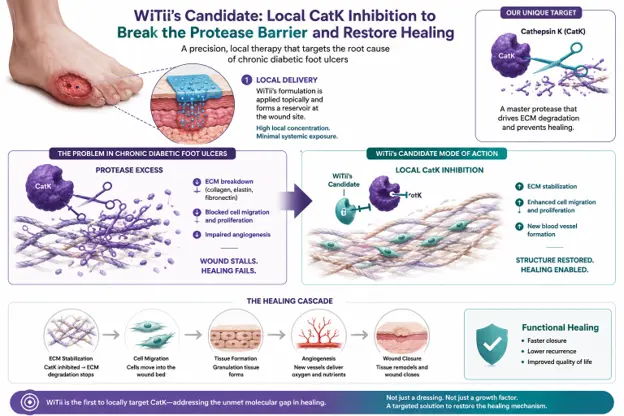
Protease Excess Stalls Healing
- Overactive CatK degrades collagen, elastin & fibronectin — destroying the ECM scaffold
- Cell migration and proliferation are blocked, preventing tissue repair
- New blood vessel formation (angiogenesis) is impaired
- Existing treatments — dressings, growth factors — do not address protease hyperactivity
Local CatK Inhibition Restores the Cascade
- ECM stabilized — structural scaffold preserved for cell attachment
- Enhanced cell migration and proliferation reactivated
- Angiogenesis enabled — new vessels deliver oxygen and nutrients
- Topical formulation creates a depot at the wound site; minimal systemic exposure
First-in-Class & Competitively Differentiated
No approved therapy specifically targets CatK or protease excess in diabetic foot ulcers. WiTii's localized inhibition strategy addresses the molecular mechanism that existing dressings and growth factors entirely bypass — establishing a defensible first-mover position at a critical, unmet biological node.
WiTii is not developing another wound therapy: we are restoring the biological conditions required for healing to occur.